Tuesday, July 19, 2011

June Nature Study: Birds

We've finally made it back on the focused-nature-study bandwagon! Last month, we decided to head back over to one of our favorite homeschooling resources, the Handbook of Nature Study blog to check out the June Outdoor Hour Challenge. We decided to focus on our own backyard and, while we can boast of many bird visitors, we have one bird in abundance: chickens!

We started off by observing our girls while they scratched around in the run. We took our colored pencils and sketchbooks with us and focused on their heads, tails and feet:


In this one above, Syler was really intent on capturing all the intricate details of the comb, the waddle, the ears, and especially the four toes.


Violet sounded out the work "chicken" all on her own. I believe the second word is "beak."


 The next day, we collected feathers from the run and labeled them. Sy was able to make out the quill, the fluff and the barb of a tail feather (above).


Violet found a wing feather and was able to distinguish between the quill and the fluff.

Tuesday, March 8, 2011

Everglades National Park

What an exciting spring break trip we've had. In addition to collecting shells and building sand castles at Fort Myers Beach, we took an amazing trip into the Everglades National Park. There, we took a ranger-led boat tour of the Ten-Thousand Islands, which was absolutely breathtaking. I, unfortunately, forgot my camera - big fail, since the kids were looking so adorable in their sunglasses and sunhats, writing furiously in their Junior Ranger Workbooks (so as to do enough prep work to be sworn in as Junior Rangers - more on that later!) We saw nesting terns, ospreys, gulls, pelicans, herons/egrets, ibis and, Syler's favorite by far, the infamous turkey vultures! We were even treated by three dolphins who decided to swim in front of, alongside and behind the boat - the kids were in absolute awe. Here's some great info on all the bird species that you can see in the Everglades.

After the tour, we drove about a mile away to the Big Cypress National Preserve where we were in for a real treat: big black alligators gliding (and hiding, rather well-camoflaged) in the swamp waters! We got out for a closer look but were warned by a ranger at one of our stops that we needed to carry the kids, since some of the alligators had been recently (illegally) fed: hence their tendency to glide toward us rather than away from us. Scary, but totally cool.

Friday, November 12, 2010

Hey Ducka Ducka!

While my kids may be avid readers, they are obsessive artists, and they don't need any coaxing to whip out the paper and pencils. Observational drawing, interpretive drawing, representational drawing - you name it, they're doing it. Here are some of their recent works:

1. Rhyming and drawing: Violet is a huge fan of Jim Aylesworth, and we currently have his The Cat and the Fiddle and More checked out of the library. One afternoon while Sy and I were out and about, she wrote her own rhyme:

Hey Ducka Ducka
The rabbit drove a trucka,
The dog learned to jump real high,
The little pig laughed to see such sport
And the spider ran away with the fly.

Then she illustrated her rhyme:


2. Drawing what you hear: we always have music one for the kids (though you won't catch The Wiggles anywhere near our stereo) and one day Jason suggested to Sy that he draw everything he heard while listening to an album by Emeralds. After about 20 minutes, Sy showed him this:

Not only did he draw the drummer, keyboardist, violinist, guitarist and "the guy making that beeping sound," but he drew them from different positions (both side and front) - this was a first, and I was totally amazed!

3. Observational drawing: this is by far the hardest! How do you paint the "whippy parts of the wind" or the gases surrounding the planets? Here is Sy's pencil drawing of the Ring Nebula, which he drew while looking at a photo from one of his space books:


4. Creative/improvisational drawing: these are my favorites. While some of them are representational, they aren't your run of the mill representations. Sy's clown is probably the easiest to "read" for the viewer:

In case you didn't notice, his hands are behind his back.

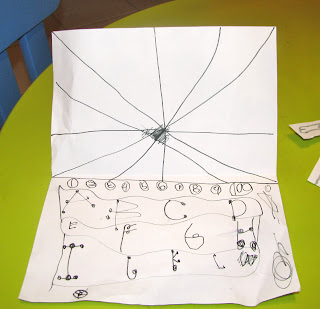
Sy's most recent "mass product" is the laptop, complete with "an ocean of letters":

But then there is Violet's lion:

Sy's crying monster:

Violet's picture of "Mommy and Invisible Sy" (that's him on the right):

And finally, Violet's "faces":

I am pretty convinced at this point that she will either be a visual or a circus artist - this stuff really blows me away.

Thursday, August 26, 2010

Cookies and Math


Syler is multiplying and "squaring" (is this a verb?) It all started with addition a few months ago: 2 cookies and 2 more cookies are 4 cookies. Now he's multiplying by twos, threes, fours and fives: "Eight twos are 16, and two eights are 16!" he exclaims at lunch one day. I ask, "How much is six fours?" He counts fours with his hands (1, 2, 3,) "4," (5, 6, 7,) "8" . . . "24!" he says triumphantly. "And four sixes?" I ask with a raised eyebrow and cheshire grin. He tilts his head, raises both brows, reflecting my grin: "24! That's a fun trick!"
He has a plate of cookies in front of him (yes, he has already finished his vegetables!). I put them into a square. "Two cookies 'squared' is four. Three cookies 'squared' is nine. How many is four cookies 'squared'?" We pull out lots of cookies and make a nice 4x4 square. "16!" Two eights, eight twos, and four fours. Cool. Why bother with the times tables when you have a table full of cookies at your disposal? Math - yum!

Monday, June 21, 2010

Salamander Walk


Our friend, Brad, took a group of us to Devil's Bathtub at Mendon Pond for a salamander walk a couple of weeks ago. Now is the time when salamanders emerge from a pond or other small body of water and crawl underneath a rock or log to begin their terrestrial life ("because it's moist under there and they won't drown from too much water, but they also won't dry up, because they need to be moist or damp on their skin," Sy explained to me afterwards).

"Salamander" is actually the common name for over 500 species of amphibians. What we discovered the most of were efts, or immature/juvenile newts. A newt is an aquatic salamander (most salamanders are terrestrial.)

These efts will all become red-spotted newts upon maturity. The kids must have spent about 30 minutes splashing through a small pond just off of the trail, each time coming back with another eft. Some of them were quite protective of those they had found, insisting that they be put right back and not passed around too much, for fear they might not survive long away from the water.

Tuesday, April 20, 2010

Unschooling in the news

A recent post by one of my favorite unschooling bloggers, Child's Play, remarked on Good Morning America's recent segment on unschooling in Massachusetts. I really appreciate her analysis of the interview, in which she addresses the overt bias and negative bent of the segment, the condescending position that "well-meaning" but "extreme" parents are allowing their children to "play hooky," and are unable to successfully put into practice a "utopian ideal." The graphics themselves suggest the unbelievability of the entire proposition: "Imagine no school: parents let kids go free" (gasp!) Some of the responses posted by readers address the positive aspects of unschooling that were edited out of the segment, and I would like to add some of my own thoughts to the discussion.

First to the issue of discourse and investigative journalism. While some may disagree, Good Morning America is not "news." Rather, it is infotainment and, as such, says a good deal about the spectators who were so incensed at the thought of American children being educated not simply outside the confines of an institution, but, further, without the institutionalization of thought. While many of those viewers were dumbfounded (and I use this term with its valences of meaning) upon discovering that parents could sleep at night knowing their children were learning without textbooks and tests, what I find most troublesome is that those same viewers are able to sleep peacefully with the assurance that Good Morning America is providing them with a "complete" and "objective" representation of what unschooling is/could be. The overwhelming popular desire for soundbites and partial truths (as long as they can be crammed in between infomercials and celebrity gossip) underscores that public/formal education does not create critical consciousness. If that were the case, Bill Moyers Journal would not be running at 10:00pm on a Friday night, and George Stephanopoulos would be out of a job.

Besides the numerous problems that Child's Play raises in regard to the segment, I would like to consider a few more. Aside from Chang's incorrect use of scare quotes ("miss" and "regret" aren't multivalent here, only "normal" is - Sy could have told her that), she asserts that school offers kids options to explore things they might not otherwise experience citing examples of Phys Ed (basketball, volleyball, etc.) Regardless of the fact that schools are offering less and less in the way of non-academic experiences (some are getting rid of recess and phys ed altogether), she seems to suggest that these are not experiences one could have outside of formal schooling. Am I wrong, or did most of us spend our childhood free time, our time outside of school, playing those games? Is it the job of school to teach us how to play basketball? Can't we learn even that on our own? And, given that unschooling is all about free time (time to choose what we will do, how we will do it, and when), it seems that unschooling will clearly provide those opportunities in excess of what the institution of school could ever offer.

Another major problem with Chang's interview is her question regarding coercive parenting. "Isn't it the job of the parent to teach the child to do things they don't want to do?" she asks. While this mode of thinking about children reveals certain mainstream assumptions about children (they have to be forced to be good/helpful/studious/well-rounded, etc.; parents and children naturally have a contentious relationship; children must be controlled if they are to develop properly) and about the society in which we raise them ("democracy" is only possible in an authoritarian form), it does not reflect the ideals and goals of unschooling. We want to raise our children to take control of their learning, to think critically about their lives and the world around them. Teaching to the test does not accomplish this. Why do we assume that children will not make the "right" choices? Or better yet, what are the "right" choices? Do we want them to run on autopilot, filling out worksheets, memorizing facts they will then dump after the test, enrolling in courses at college because "it's what I've always done," because their "parents think it's a good idea," because they "don't know what else to do"? (Yes, spoken from the mouths of my freshmen advisees - they are 18 and still don't know what they want out of life.). Is it "right" for them to go to college if, after graduating, their career expectations are thwarted because of a failing economy that no one seems to know or understand how to fix?

What does this fear of (not) learning without tests and textbooks say about our ideas of learning, our (lack of) respect for children's inherent desire to learn and their natural ability to do so? Aristotle said that all men, by nature, desire to know; that what we have to learn to do, we learn by doing. Are either of these assertions fulfilled via standardized testing and textbook learning? Many great thinkers and poets were wary of the institution of school because they saw that it went hand in hand with the institutionalization of thought (Mark Twain and Friedrich Nietzsche being only a couple who are famous for their scathing critiques). Perhaps our true fear is of a nation of critical thinkers - that would be a difficult citizenry to manage (again, no scare quotes here.)

Elsewhere, I have discussed some of the reasons we have chosen against formal schooling. While I would not assert that our parenting could be defined as "radical unschooling" (we do place some limits on diet, access to commercial TV and other forms of media, bedtimes and hygiene), we are doing our best to facilitate our children's learning, rather than educate them, and we are attempting to do so with respect and without coercion in the form of punishments or rewards. We read a lot. We travel. We play sports. We hike and play in nature. We do research on the internet. We make art. We sing, dance and make music (including formal lessons and informal play). We snuggle. But I think the most important aspect of our unschooling journey is the respect we have for our children's right to make decisions and assert their agency. They don't *have* to read about this or that, just like they don't *have* to apologize (when they don't mean it!) or clean up the playroom (unless they've decided it's easier to play down there when they can find their stuff.) The result? They read a lot, and they read what they want. They argue, but they are kind and considerate of each other's feelings, often offering help and apologies without us hovering and enforcing "correct" manners. They question assertions; they see grey (as well as black and white); they wonder and consider and hypothesize. They act like human beings because we treat them as such.

Saturday, April 17, 2010

Ephemera (1)

Family room. Coffee started, not yet consumed. Children seek out objects to occupy their time. Mama arranges her reading spot on the couch. Oldest child approaches.

Sy: We have an office with scare quotes.
Mama: No, Sy, we have an actual office - that's without scare quotes.
Sy: No, me and Violet have an office with scare quotes! See what I mean?

Tuesday, April 13, 2010

Think! Project: Cantilevers


We decided this past week to try our first Think! challenge. The wonderful thing about the Think! challenges is that mechanical engineering becomes a kind of everyday experience - who knew? Our first challenge: using only one roll of scotch tape and 100 straws, build the longest cantilever you can.

We started by looking up cantilevers on wikipedia (I know, this is not the same as doing research with the card catalogue at the local library, but hear me out). After getting a basic definition of a cantilever - a beam supported on only one end - we then looked at and discussed photos of various types of cantilevers. Then we got out our blocks to try to imagine how to go about building ours. Finally, we counted out straws and got to work. Ours measures 54 inches. Pretty cool, eh?


Sunday, March 14, 2010

Planting the seeds


Well, it's that time of year again, when we order our seeds (or pull some from last year's stash out of the fridge) and get to planting! Yes, our gardening adventures are getting underway, and we have already spent 2 weekends learning about and planting our seeds.

We started in mid-February with tomatoes (heirloom and Riesentraube - giant cherries), carrots, eggplant, onions, broccoli, lettuce and some lovely annuals, giant zinnias and African Star of the Veld. We borrowed some grow lights (actually just full spectrum lights) from our friend Lily, brought up a storage shelf from the basement, and set to work. First, Sy and Vi sat down to make labels for the seed trays.


Then we added peat pellets to our trays and watched them "grow" with warm water. Once our trays were ready, we pulled out a packet of seeds, read about their origins, light preferences and growth tendencies, and took turns planting them. It was really cool to see how different each seed was.


At the beginning of March, we planted another round of seeds: pumpkin, chives, smaller zinnias, a new perennial - cupid's dart - as well as our herb staples - basil, rosemary and cilantro (we have so much thyme left over from last year, we decided not to plant anymore!) The pumpkins have really taken off and are already bigger than the Star of the Veld:


pumpkin


Star of the Veld

By mid-March we already needed to do some transplanting, and it seems to have been successful: our tomatoes, broccoli and lettuce have all sprouted new leaves since transplanting. Next weekend we will be transplanting the rest of our seedlings into 2- or 4-inch pots. Our efforts have been very fruitful, indeed.


lettuce


tomatoes

Thursday, March 4, 2010

R is for Reading


As a homeschooler, I am constantly aware of what my kids "should" be learning, according to school-based requirements, according to my own experiences in school, and according to general social expectations. Reading is always on my mind, and can at times become a source of anxiety. While the days of Syler's infancy and early toddlerhood were filled with hours (literally) of reading, as our family grew each child became more interested in and able to accomplish other things. Some days are simply too full of these other things: hikes and nature play, soccer and gymnastics, piano lessons and music class, dress up and make believe play, painting and working with clay, and so on. Some days we only open one or two books. (gasp!) I say this jokingly, but as someone who reads for a living, it can be a source of guilt.

And while Syler was quite keen on doing his alphabet puzzles, tracing his letters and learning the sounds that accompany each, Violet is far from being a fan of phonics. However, one thing remains: they absolutely love to be read to. Picture books, chapter books, rhyming books, poetry, in English or German, each has them sitting and listening for as long as you, not they, have the patience.

And now, Sy is reading to us. Not just his Bob Books but also Hop on Pop; Panda Bear, Panda Bear, and he reads to us from his Your Big Backyard issues! His voracious appetite for reading has even been encouraging Violet - not only does she sit down to read to her baby, Mickey, and to us, but she points out letters while driving along in the car and she's really become interested in how different letters have similar shapes.

In fact, my anxiety about their ability to learn to read is about as silly as anxiety about them learning to walk or talk. As Margaret Phinney has suggested, the only thing children need to become good readers is a reading-friendly environment that includes real books (not level-appropriate readers!), someone to read to them and with them, a risk-free environment to practice, and time. Oh, and the parents have to be reading, too.

Sunday, February 28, 2010

winter wonderland


We have spent much of the winter playing hard. We begin each week with our Tracks & Trails group (formerly referred to as waldschule, we made the change because people had trouble pronouncing it). Regardless of the amount of snow on the ground, as long as it's 20 degrees or above, Monday finds us in the woods tracking animals, converting sticks into swords, climbing trees, comparing mosses, spotting cardinals and bluejays, listening for deer and other woodland creatures, climbing hills and using our bums as make-shift sleds. While we often don't make it very far into the trail - because we've discovered a magical shelter someone left behind, a giant log that resembles a dragon or simply because Violet is, yet again, demanding cheese - our time spent in the great outdoors is never wasted.


Two weeks ago was the Great Backyard Bird Count, organized by the Cornell Lab of Ornithology. In preparation, Syler pulled out our Birds of New York Field Guide and got to work looking up all the birds we typically see in our backyard during the winter. He then made a list of birds we were likely to (or really wished we would) see:


While we did not see a Bald Eagle or a Brown Thrasher, we did see a Hairy Woodpecker, several Bluejays, a Red-Bellied Woodpecker, Chickadees, Nuthatches, Tufted Titmice and several Cardinals. We then forgot to keep track of how many. Oh well.

This past weekend was the weekend of winter bliss! Sledding, igloo building, and snow eating. Mmmm . . .


Sunday, November 15, 2009

Why do we homeschool?


Sy contemplates his homemade "light saber" complete with a fleet of flying "attack mice."

Like so many other parents who homeschool, we are regularly beset with questions regarding our decisions to do so. And, while I often welcome the opportunity to explain to others the potential joys of keeping your kids at home and allowing them to "grow without schooling" (which is what they've been doing successfully so far), it is a near impossibility to explain this in the 10 minutes or less that most people expect. One of the unschooling blogs I've recently discovered has a very succinct answer to this question.

Like this homeschooler and many others, there are hundreds of reasons why we choose to homeschool, and why we have decided to unschool in particular. Here are just a few of the reasons why we choose to homeschool:

  • School is authoritarian: schools are designed "for the scientific management of a mass population. Schools are intended to produce . . . human beings whose behavior can be predicted and controlled" (Gatto Dumbing Us Down 23); in school, children are discouraged from questioning adults and school rules, and are often punished when they don't obey.
  • School is contrived: learning takes place away from the real world, and children often have difficulty making connections between what they learn in school and how that knowledge can be practically applied in the world around them (my own experience with math attests to this).
  • School segregates: children are grouped by age; class and race divisions in the community often determine that most schools are homogenous, rather than heterogenous; and adults are present as authority figures, not as friends or allies. Thus, children's socialization is artificially homogenous in comparison to the diversity of ages, classes and races they will come into contact with upon leaving school.
  • School does not provide children with healthy lifestyle options: children (even Kindergarteners!) are tied to their desks for many hours per day, recess and physical education are being reduced and in some cases eradicated all together, school food is over processed, fatty, loaded with sugar and has little nutritional value.
  • School encourages consumerism: in addition to the fast food options available at lunch, children are the targets of marketing everywhere in their schools, from the vending machines, to the curriculum materials, to the advertising on their sports equipment, to bus radio.
  • School is not for learning: children are forced to read and perform according to a uniform curriculum - they have no voice in curricular choices; their intellect is not respected nor is it encouraged; their love of learning is strangled and "learning" (facts, dates, correct answers for standardized tests) becomes work; they focus on extrinsic rewards, which inhibits learning and makes what they have learned difficult to translate into practical situations.
  • School teaches competition, rather than collaboration: "Researchers have found that competitive structures reduce generosity, empathy, sensitivity to others' needs, accuracy of communication, and trust" (Kohn "Is Competition Ever Appropriate"); this seems contrary to their development as caring, helpful and sensitive family members, neighbors and citizens.
  • School encourages the pseudo-diagnosis of attention disorders and the overmedication of children: forcing children to conform to the unnatural context of school (sitting still for long periods of time, forcing direct attention) and neglecting their inquisitive, explorative, demonstrative natures.
  • School teaches patriotism (read "nationalism"), rather than civics: if a thriving democracy depends on it citizens to be critical thinkers, who understand the necessity of questioning, critiquing and, when necessary, actively seeking change, then patriotism is a thorn in the side of democracy.
These are some of the many reasons why we have chosen to grow without schooling. Next up: why we think "unschooing" is for us.

Tuesday, September 15, 2009

Storytelling


We just discovered a wonderful new resource online thanks to one of our unschooling friends: Storybird! It is a free resource for creating stories to share online. The artwork is inspiring, and you can collaborate with others in writing your story. Sy has chosen to start with the artwork of Victoria Usova, who states that her inspiration is a mixture of Rublev, Chagall, Hokusai, and Dr. Seuss. Be sure to check it out! Sy's first storybird begins, "the trees have faces. happy, princess faces." We'll let you know when the tale is all told!

Thursday, August 13, 2009

Busy Bees

Well, this has been a rather busy summer for the Peck-Creech clan.

Sy has almost finished the first Suzuki book, and has now begun improvising with left hand chords and right hand virtuosity. He gives us regular concerts. This involves zero negotiation, since he sees this as a joyful act in and of itself. Alfie Kohn would be proud.

Violet is learning how to use the potty all on her own, without the "help" (or hindrance, shall we say) of the infamous (and ineffective, perhaps even traumatizing) potty party touted by some as "effective" and "enjoyable" (yeah, right.) Okay, so maybe we are clapping and singing her praises, but there is no chocolate or threat involved, so I think we're on the right track.

We are watching our garden grow (and get rather weedy). The kids can identify all of the mints, the zinnias and bee balm, and enjoy walking on the cushy irish sagina moss around the wigwam.

We have spotted a hummingbird at the bee balm, and have discovered lots of wildlife in the backyard: besides the usual suspects (caterpillars, toads, rabbits, deer) we have a large family of wild turkeys that walk through a couple of times per day, browsing in the butterfly garden. Our woodchucks have disappeared - I imagine they have found other foraging spots, but we certainly miss them.

The Waldschule has taken off! Our first trip was to Mendon Ponds Park with the Rochester Butterfly Club. There we were introduced to a variety of caterpillars, including that of the Cecropia Moth (beware of hairy and colorful caterpillars - they can be aggressive!)

We also saw a crysalis up close

spotted a Common Wood Nymph

a White Admiral

and a Cicada Killer (including two flying through the air, bum-to-bum, in a mating dance!)

We ended the afternoon with a lovely picnic while the kids frolicked under the trees and transformed into birds of prey.


Sy has started reading the Bob Books First! series and thinks they're pretty cool. He has read almost all of the first book in the first series. It has also been the summer of the fairy tale, and we have been reading our favorite Grimm and Andersen tales all summer (only the Svend S. Otto and Lisbeth Zwerger versions, of course, since we adore the illustrations!) and listening to a few on LP. Violet continues to ignore her ABCs and give all the wrong answers when you ask "what color is this?" I think she's figured out that she's "supposed" to know and is just pulling one over on us.